Last week’s LookUpStrata webinar focused on changes to an embedded network in WA, including the code of practice, a topic that is rapidly gaining importance for strata managers, councils of owners and lot owners. Damian Moran from EnergyTec and Scott Bellerby from B Strata explained how embedded networks work, outlined the current legal landscape in WA, and walked through the upcoming Embedded Network Code of Practice. The session highlighted practical steps schemes can take now to improve transparency, prepare for registration, and position their buildings to benefit from solar, batteries and smart metering.
What is an embedded network
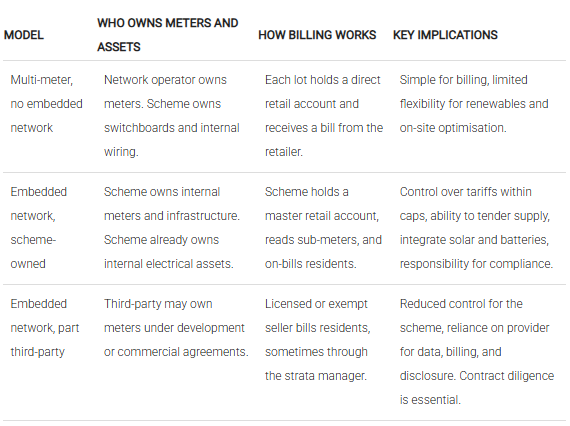
An embedded network is a private electricity distribution system within a scheme that connects to the main grid through a single master “gate” meter. The scheme then manages internal metering and billing for lots. This is different to a traditional multi-meter arrangement where each lot has a direct account with the retailer. In an embedded network, the owners corporation can procure energy on contestable terms, manage on-selling within the limits of gazetted tariffs, and integrate generation such as solar and batteries.
Common billing models and who owns what
Regulatory framework in Western Australia, current and emerging
WA schemes with embedded networks generally operate under exemptions rather than full retailer licences. Existing obligations already arise across several instruments, including the Electricity Industry Act, the Energy Coordination Act for gas, the Strata Titles Act, tenancy legislation and consumer protection laws. The state is introducing a new Electricity Embedded Network Code of Practice under the Alternative Electricity Services framework. The policy intent is to lift customer protections, mandate clear disclosure, and provide access to the Energy and Water Ombudsman for independent dispute resolution.
Embedded Network Code of Practice, timeline and what it means
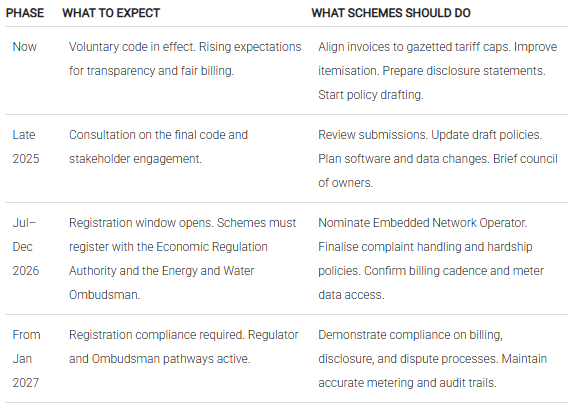
A voluntary code is already in effect. Government agencies and large customers expect alignment now. The final code is expected following consultation in late 2025. Registration of schemes will commence in the second half of 2026, with mandatory registration deadlines in early 2027. Registration will require an identified Embedded Network Operator, documented policies and procedures, and adherence to billing, hardship and dispute resolution standards.
Pricing guardrails and billing cadence
Residential on-selling must not exceed gazetted A1 tariffs for the applicable supply area. Supply charges recover reasonable metering, data and administration costs, while usage charges reflect consumption. The code is expected to set a maximum billing period of two months, which means schemes and managers will need reliable meter reads, timely data and dependable invoicing workflows. Clear itemisation and advance notice of fee changes will be required. Where a meter fault requires estimation, schemes must document the estimation method and mark invoices accordingly.
Disclosure, hardship and disputes
The code’s focus is transparency. Residents should receive an information pack that explains who supplies electricity, what tariffs apply, how billing works, and how to lodge complaints. Schemes should adopt written hardship and payment support policies that apply consistently to utilities and, where appropriate, to levies. Complaint handling procedures should include an internal pathway and an escalation route to the Energy and Water Ombudsman if issues remain unresolved.
Governance, compliance and record keeping
Councils of owners should move from informal practices to documented policies adopted at a general meeting and reviewed annually. Bylaws may need updating to recognise embedded network operations, metering access, data sharing, renewable integration and billing processes. Schemes should keep meter accuracy records, usage histories and decision logs. They should also understand when utility on-selling creates assessable income that requires an annual tax return. Where a third-party provider is involved, the strata company should still maintain its own policies, request regular data and require clear resident-facing disclosures.
Opportunities for savings and resilience
Embedded networks can unlock value when schemes tender electricity on contestable terms, use smart metering to identify waste, and integrate solar and batteries to offset grid energy. Many schemes choose to recover at the tariff cap and return any surplus as reduced levies or reserve contributions. Interval data enables targeted actions such as adjusting plant schedules, fixing leaks in common services and right-sizing future renewables. Conversion from a traditional multi-meter setup to a scheme-owned embedded network can also create a funding pathway for end-of-life electrical infrastructure upgrades.
Case studies and real-world lessons
Recent WA examples show schemes halving electricity costs after embedding networks and procuring supply competitively, noting that wholesale movements can reduce some gains. Other schemes have used embedded network recoveries to fund switchboard replacements and modern metering. Success correlates with accurate data, clear resident communications and early policy adoption. Where third-party ownership constrains transparency, schemes benefit from negotiated disclosure and service standards written into agreements.
What to do next
Start with a compliance gap review. Assemble current invoices, meter lists, tariff settings and contracts. Draft a resident information pack that explains billing, tariff caps and complaint pathways. Prepare hardship and dispute policies, and set up a two-monthly billing rhythm that your software and meter partners can support. If you plan solar or batteries, commission a feasibility study that incorporates interval data and a procurement strategy. Put policy adoption on the next meeting agenda so the council of owners can formalise the approach and review it each year.
Resources
- Download the presentation slides: Embedded Networks in WA Strata
- EnergyTec News & Insights


Log in to your existing Lookupstrata Account to download:
- Webinar slidepack
- Transcript

With over 38 years of experience in mechanical services, sustainability, and energy management, Damien has led EnergyTec since acquiring it in 2015. Under his leadership, the company evolved from utility billing and metering into a pioneer in energy technology, delivering renewable energy and automated metering projects. He previously co-founded HFM Asset Management and has served on multiple boards.
Damien’s expertise in energy procurement and utility systems has driven the deployment of over 8MW of solar and metering infrastructure across commercial properties in WA and the Eastern States. He is also a Board Member and Secretary of the Strata Community Association (SCA), where he leads the Sustainability Taskforce, and served as a judge for the Property Council of Australia Awards in 2024 and 2025. Passionate about simplifying complex systems, Damien empowers clients to make informed decisions while continuing to drive innovation and growth at EnergyTec.

With nearly two decades of property experience, including working as an expert in litigation as both a commercial property valuer and a retail development manager, Scott is now regarded as WA’s lead strata expert.
Scott started with B Strata early 2014 and became managing director mid-2015. He dedicates the majority of his time to B Strata, growing and evolving the business and managing existing and new developments as they come online.
Given Scott’s passion for strata and broad property experience he was quickly elevated to President of Strata Community Association WA in 2016 and is now the longest continuing serving President of the Association.
Scott worked extensively for over five years with Landgate, the Property Council, SCA WA and the Ministers for Land to ensure a balanced and effective review of the Strata Titles Act was achieved. Scott’s ultimate aim is to see the strata industry recognised for its professionalism and expertise and wants to ensure there is proper regulation and licensing of strata managers.
Scott sits on numerous Boards and committees, including the Property Council of Australia, Policy Advocacy Committee and he Chairs the SCA WA Board.
Hands down, B Strata are industry leaders when it comes to understanding the strata reforms and implementing new processes to accommodate for the changes to the legislation. Saying this, we will not be ‘resting on our laurels’, as we continuously look to find ways to innovate and evolve!
B Strata's mission is to create harmonious communities.
Scott is a regular contributor to LookUpStrata.