Last week’s LookUpStrata webinar examined whether flood insurance is mandatory for bodies corporate in Queensland. The session featured Will Marquand from Tower Body Corporate, Todd Garsden from Mahoneys, and Tyrone Shandiman from Strata Insurance Solutions. Together, they unpacked the legal, practical and financial implications of flood cover, offering insights into how bodies corporate can navigate risk, regulation and owner expectations.
1. Is flood insurance mandatory for bodies corporate? Legislative context & the Commissioner’s position
Building on the Issue 50, June 2025 Common Ground newsletter from the BCCM, the Commissioner’s guidance states that bodies corporate must be insured for water damage, which may include floods. So, is flood insurance mandatory for bodies corporate in Queensland? If flood cover is not present, it needs to be explicitly added. Owners may request inclusion and the committee must consider it; if denied, a motion can be taken to the next general meeting.
However, this wording leaves ambiguity. Many interpret it as optional rather than mandatory, which is frustrating for stakeholders seeking clarity.
2. Presenters views: Tightening the interpretation
Todd Garsden from Mahoneys: Legislation requires insurance for water damage which largely includes flood. Adjudicators have contested this, but some recent rulings state that if a building is in a known flood-risk zone and flood cover is available, it would be unreasonable not to have it.
Tyrone Shandiman, Strata Insurance Solutions: Insurers vary: some don’t offer flood cover at all; others make it optional; some include it automatically in low-risk zones. High-risk properties are often excluded or face steep premiums.
Will Marquand from Tower Body Corporate: From a strict legal perspective, flood should be treated as water damage and thus be mandatory when risk is identified and cover is obtainable. When it's unavailable, adjudicator exceptions may apply, but committees bear liability for costs if uninsured flood damage occurs.
3. Insurance risks when flood cover is absent
If flood cover is omitted and flood occurs, the body corporate could face liability for repair costs that exceed what insurance would have paid. Owners might pursue legal claims against committee members for failing statutory duties. Some policies include exclusions for failure to maintain insurance, putting office bearers at financial risk.
While office-bearers and public liability insurance may respond, cover depends on whether the legal cause relates to the ownership or management of common property.
4. Practical scenarios and advice
During the webinar, presenters explored real-world examples. For high-rise or hilltop buildings with no flood history, committees may reasonably omit flood cover if risk is truly negligible and cost is material. For buildings near flood zones, panellists recommend strong consideration of flood insurance, even at a higher premium.
The key message: always request insurance quotes with and without flood cover, assess the risk, and document the rationale behind decisions.
5. Record-keeping and documentation
Committees should maintain clear records, including:
- Flood mapping and hydrology reports
- Insurance quotes with and without flood cover
- Meeting minutes that explain the decision-making process
- Committee notes or motions from owners regarding cover
Summary table: Key issues for bodies corporate
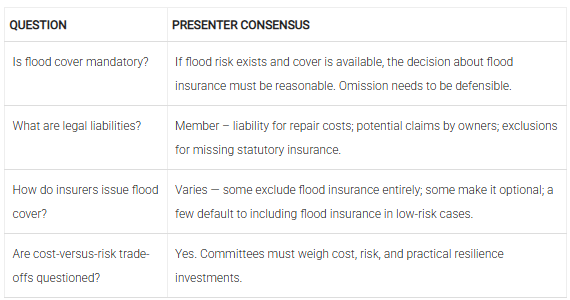
Actionable steps for all stakeholders
For committees and strata managers
Review flood risk using mapping tools and past records. Seek insurance quotes both with and without flood cover and compare pricing. Ensure decisions are minuted in detail. If the issue is contentious, take it to a general meeting and allow owners to vote. Escalate unresolved disputes to the Commissioner for adjudication.
For lot owners
If you believe your scheme should have flood insurance, raise it with the committee. If ignored, submit a motion to the general meeting. If still unresolved, pursue adjudication through the Commissioner’s office. Document your position clearly.
For industry professionals
Support clients in evaluating flood risk and interpreting their legal obligations. Highlight the consequences of underinsurance and encourage thorough documentation of all decisions. Promote transparency, especially where flood exposure is a realistic concern.
Final thoughts
The webinar revealed that the flood insurance obligation under Queensland strata law remains complex. The Commissioner’s language leaves room for interpretation, but recent adjudications suggest flood insurance is required where there is risk and where policies are available. Until clearer legislative direction is given, the best protection for committees and owners is transparency, documentation and well-reasoned decisions.
In high-risk areas, the price of coverage is often justified when weighed against the financial and legal consequences of being uninsured. Even in low-risk zones, flood cover may be worth securing if the cost is modest. In all cases, schemes should take reasonable steps to protect their assets and act in the best interests of all lot owners.


Log in to your existing Lookupstrata Account to download:
- Webinar slidepack
- Transcript
Will Marquand joined the Tower team as a General Manager and Senior Strata manager in 2020. He has widespread experience across all forms of commercial, industrial and residential schemes. He believes in proactive, ethical strata management and hopes to provide Tower’s customers with the knowledge and support required to take their schemes forward into the next generation of body corporate management. Will has experience working across residential, commercial and industrial schemes. A former journalist and teacher, Will's excellent communication skills help Tower grow its expanding business. William is a regular contributor to LookUpStrata.

Todd is an experienced property lawyer who heads up Mahoneys body corporate team.
Todd specialises in body corporate law and predominantly acts for bodies corporate, body corporate managers and lot owners on all matters affecting bodies corporate.
Todd is an active member of the Strata Community Association (Qld). In 2019 he was appointed to the Strata Community Association (Qld) legislation committee and assists in making submissions on behalf of the Strata Community Association (Qld) on issues such as legislative reform in body corporate law.
As Todd is also a body corporate committee member, he understands the day to day requirements of administering a body corporate.
Todd has a focus on achieving practical and commercial results for his clients and understands the market in which bodies corporate operate within.
Todd also provides body corporate managers, and other industry stakeholders, with presentations and training on matters affecting the body corporate industry.
Tyrone Shandiman is a seasoned professional in the insurance industry having embarked on his journey in 2004 within the financial services sector. In 2011, he established Strata Insurance Solutions, transforming a garage startup into a reputable firm servicing over 900 clients with a dedicated focus on strata insurance. Tyrone's role extends beyond managing operations and tackling complex insurance matters; he also founded the Australian Consumers Insurance Lobby, championing consumer rights within the insurance industry. Notably, his efforts and expertise have been acknowledged with numerous industry awards. Adding to these accolades, Strata Insurance Solutions was recently named an Australian Top Brokerage by Insurance Business Australia Magazine, a testament to the firm's excellence and leadership in the field. Tyrone is a regular contributor to LookUpStrata.