Last week’s LookUpStrata national webinar explored how new rules on unfair contract terms and insurance commission disclosure are set to transform strata practice across Australia. The session featured special counsel Carolyn Meighan and Julia Moroz from Bugden Allen Group Legal, who unpacked the 1 July 2025 NSW reforms, the wider application of Australian Consumer Law (ACL) protections, and new ASIC-informed consent requirements for insurance commissions. The discussion offered insights for strata managers, committee members, and lot owners on navigating legal change while improving transparency and governance.
1. NSW unfair contract term reforms
From 1 July 2025, NSW extended ACL unfair contract protections to owners corporations and community associations. This reform closes a long-standing gap where these bodies fell outside the ACL’s definition of "consumer", leaving them bound to one-sided terms in standard contracts such as strata management agreements, building services, and cleaning or gardening arrangements.
Under the ACL, a contract term is unfair if it:
- Causes significant imbalance between the parties’ rights and obligations.
- Is not reasonably necessary to protect the benefiting party’s legitimate interests.
- Causes detriment, financial or otherwise, if relied upon.
As Carolyn Meighan observed during the webinar, the legal meaning of "unfair" here is different from its everyday use. In general speech, unfair often carries a moral judgement or a personal opinion. Under the ACL, however, it is a precise legal standard tied to the three criteria above. A clause might feel reasonable to a layperson but still be legally unfair, or it might seem harsh yet not meet the legal definition. This distinction is crucial for committees and managers assessing contracts under the new rules.
Common examples of unfair terms in strata contracts include:
- Causes significant imbalance between the parties’ rights and obligations.
- No accountability for subcontractors.
- Assignment of the contract without owners corporation consent.
- Unequal penalties for termination.
If declared unfair by a court or tribunal, such terms are void from the outset. While the remainder of the contract can still operate, there are also potential penalties and the option to void or vary the entire agreement.
It is important to note the following points:
- Applies to standard form contracts renewed or varied on/after 1 July 2025.
- Does not apply retrospectively to contracts already in place before that date unless they are renewed or varied.
The section 24 test
Under section 24 of the Australian Consumer Law (ACL), a contract term is considered unfair if all three of the following apply:
- Significant imbalance – The term causes a significant imbalance between the parties’ rights and obligations.
- Not reasonably necessary – The term is not reasonably necessary to protect the legitimate interests of the party who benefits from it.
- Detriment – The term would cause detriment (financial or otherwise) if applied or relied upon, even if the detriment is only potential and not actual.
Note: Transparency is relevant but not decisive. A clearly worded term can still be unfair, and the assessment focuses on the specific term in the context of the whole contract.
2. Implications beyond NSW
Other jurisdictions have not yet adopted identical reforms. In WA, for example, applicability depends on whether small business protections under the ACL are triggered, assessed case-by-case. However, the NSW changes could act as a catalyst for national reform. Even without legal change, reputational and enforcement risks make it prudent for strata managers and committees in all states to review contracts now.
The core message: these provisions are about balancing power in contractual relationships by ensuring neither side can use bargaining strength to the detriment of the other.
3. Informed consent for insurance commissions
Separate from the NSW changes, new ASIC-informed consent rules under the Corporations Act and ASIC Act apply nationwide. They require any Australian Financial Services licensee or representative (including brokers and sometimes strata managers) who earns commission from general insurance products to obtain written client consent when giving personal advice to a retail client.
Consent must disclose:
- Insurer’s name.
- Commission rate, frequency, and duration.
- Services provided in exchange for commission.
- That consent is required by law and irrevocable.
Consent is ongoing if unchanged, but any change to commission terms requires fresh consent. Written records must be kept for five years, and copies provided to the client.
The aim is greater transparency on who is paid, how much, and for what, reducing conflicts of interest and ensuring owners corporations/bodies corporate can make informed insurance decisions.
4. Practical actions for strata stakeholders
The presenters recommended all parties act now rather than wait for contract renewal:
For committees and strata managers:
- Audit existing contracts for one-sided terms and high-risk clauses.
- Remove or amend unfair terms where possible.
- Formalise informed consent processes for insurance commissions.
- Train committee members and staff on ACL reforms and contract fairness.
- Seek legal advice before renewing or varying agreements.
For lot owners:
- Ask for copies of contracts and commission disclosures.
- Propose motions at general meetings to adopt fairer terms or commission transparency policies.
- Escalate concerns via internal dispute resolution, tribunals, or the Commissioner if necessary.
For industry professionals:
- Update precedent agreements for compliance.
- Ensure disclosure obligations are met for commissions.
- Use reforms as an opportunity to build trust with clients.
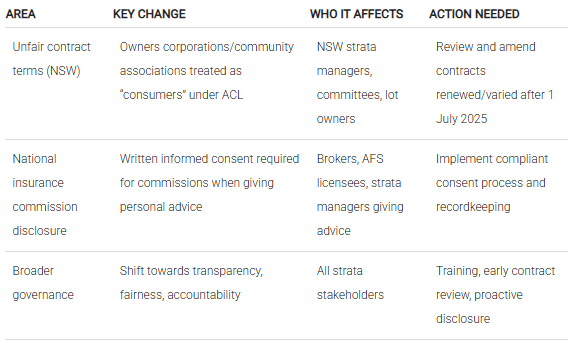
5. Summary of key changes
6. Final takeaways from the presenters
Julia Moroz emphasised that the changes are a reminder of strata’s consumer-protection character: “It’s a timely moment to review contracts and be prepared.”
Caroline Meighan highlighted the long-term benefits: “While sometimes seen as detrimental to managers or service providers, these changes can improve relationships and outcomes for everyone if approached positively.”


Log in to your existing Lookupstrata Account to download:
- Webinar slidepack
- Transcript

Carolyn Meighan is a seasoned legal practitioner with over 20 years’ experience in property and strata law, now serving as Special Counsel in the Perth office. She advises strata companies, managers, and lot owners on all aspects of strata contracts, ranging from insurance and by‑laws to contractor and agency agreements, including drafting, interpretation, and dispute resolution.
Carolyn is a pragmatic litigator, regularly representing clients in State Administrative Tribunal, Supreme, Federal, and High Court proceedings. Her expertise in contract fairness, commission disclosure, and governance makes her uniquely positioned to lead this session on fair contract principles in strata insurance and beyond.

Julia Moroz brings a sharp legal mind and a commercial approach to resolving complex disputes in strata and insurance. With cross-jurisdictional experience, spanning WA, VIC, NSW, QLD, and TAS, she advises clients on contract risks, policy interpretation, professional liability, and regulatory reform. Julia has acted for a broad mix of stakeholders, including insurers, brokers and owners corporations, and is particularly sought after for her work on insurance recoveries and compliance matters.
Her experience includes navigating Victoria’s Section 23A insurance changes, subrogated recoveries, and fault-based levies. Julia’s strength lies in translating dense legal issues into practical guidance, particularly where strata insurance intersects with disclosure obligations and evolving contract law.