Insurance commissions in NSW strata are under intense scrutiny. Should they be banned? Reformed? Better disclosed? Or better managed?
Alert 24 March: The NSW Productivity and Equality Commission’s report was released today and is available here Strata commissions review: the market impacts of prohibiting conflicted payments. For more information, see the Media Release from NSW Fair Trading here Ending commissions for strata managers could save NSW $333 million over 15 years.
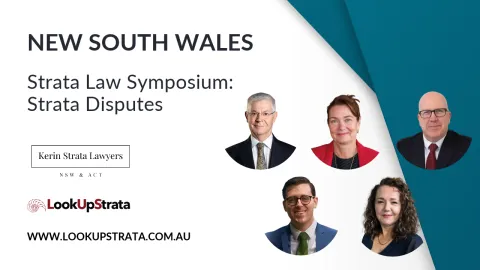
This special 90-minute panel brought together leading voices from the NSW strata and insurance sectors for a robust, respectful debate on where things stand right now and where they should go next.
With perspectives spanning advocacy, regulation, insurance and frontline strata management, the panel's lively discussion highlighted a sector grappling with competing priorities:
- transparency,
- consumer outcomes,
- business sustainability and
- professional standards.
NSW strata insurance commissions panel positions
Where did each panellist sit on the issue of insurance commissions and reform?

A sector divided on the path forward
One of the clearest themes from the discussion was that while there is broad agreement on the need for reform, there is no consensus on how that reform should look.
Some panellists strongly supported moving away from commissions. They said commissions create an inherent conflict of interest, disclosure alone does not resolve conflict, and removing commissions can simplify decision making and help rebuild trust.
Other panellists said commissions can still be a legitimate and workable part of the industry when managed correctly. They pointed out that commissions help offset strata management fees, support business sustainability, and can be transparently disclosed and controlled.
This divide reflects a broader tension across the sector, between eliminating conflicts and managing them effectively.
Disclosure vs informed consent
A key point of contention was whether the current disclosure regime goes far enough.
While recent NSW reforms require detailed breakdowns of insurance quotes, several panellists questioned whether volunteer committees have the expertise to interpret complex disclosures, whether those documents are actually read and understood, or whether they create a "tick-the-box" approach to compliance.
As one perspective highlighted, it is entirely possible to present a fully disclosed, but still poor, insurance outcome if the decision-making process relies too heavily on trust in the strata manager. The deeper issue is whether disclosure equals transparency or just the appearance of it?
Fiduciary duty and conflict of interest
The concept of fiduciary duty sat at the centre of the debate.
Some panellists argued that strata managers cannot fulfil their fiduciary obligations while receiving commissions, conflicts in this context are too difficult to manage in practice, and the only effective solution is removal.
The panel also suggested that conflicts exist across many industries and can be managed through better structure and governance. They pointed to practical solutions such as limiting delegated authority, separating advice from facilitation, and strengthening enforcement of existing rules rather than introducing blanket bans.
The big question: Will banning commissions reduce costs for owners?
A major area of disagreement was whether banning commissions would leave consumers better off.
Supporters of reform argued that removing commissions:
- should reduce insurance costs
- creates a clearer, more transparent pricing structure
- aligns remuneration with service delivery
- a one-in, one-out example was mentioned
Opponents warned of unintended consequences:
- strata management fees would likely increase to replace lost revenue
- brokers may still retain commissions unless reforms extend further
- and consumers could end up paying in different ways rather than less
Overall, attendees were reminded that removing one part of the remuneration chain does not necessarily reduce costs in the system.
Consumer choice and business models
Another key theme was consumer choice and market diversity. Some panellists said different business models should coexist so that consumers can choose between fee-for-service and commission-based arrangements. Others cautioned that not all options operate with the same level of fairness or transparency, and that some models may disadvantage consumers.
There was also discussion around vertical integration, with differing views on whether integrated service models enhance efficiency and value, or introduce additional conflicts and complexity.
Trust, professionalism and the future of the industry
The conversation also reflected on the broader reputation of the strata sector, particularly following recent media scrutiny.
Panellists acknowledged that trust has been challenged in recent years, with a minority of poor practices impacting perception across the industry. Rebuilding confidence will require not just compliance, but a stronger focus on professionalism, transparency and consistent service delivery.
There was also concern about the profession's long-term sustainability. Increasing regulatory burden, rising expectations and tight margins are placing pressure on businesses and individuals alike. Without change, the sector may face a shortage of experienced strata managers and a decline in service quality.
What happens next? For now, we wait
While the panel did not reach consensus, it made one thing clear: change is coming and for now, we are all waiting to hear from the NSW Government what that looks like.
With the NSW Productivity and Equality Commission reviewing the issue and government decisions pending, the sector is preparing for a potential shift in how it manages remuneration, transparency, and accountability. The direction taken will have long-term implications for business models, consumer outcomes and the future of the profession.
Practical takeaways
For strata managers

For strata business owners

The bottom line
The NSW strata sector is at a turning point.
What came through clearly in this panel is that the conversation about insurance commissions is no longer only about remuneration. It has become a broader discussion about trust, professionalism and the long-term sustainability of the strata management model.
While opinions differ on whether commissions should be removed or better managed, there is strong alignment on the underlying issues. Transparency must go beyond compliance. Disclosure needs to be meaningful, understood and supported by clear communication, not buried in complex documentation.
Trust also sits at the centre of the debate. Owners and committees rely heavily on strata managers to guide critical financial decisions, particularly around insurance. Where that trust weakens, whether through poor practice or perception, the entire system comes under pressure. Rebuilding that trust will require consistent behaviour, clearer boundaries and a stronger focus on acting in the best interests of the owners corporation at all times.
At the same time, the discussion highlighted a growing concern about sustainability. The current pricing structures in many parts of the industry do not reflect the increasing complexity, compliance burden and risk carried by strata managers. Any reform, whether it involves commissions or not, will need to address how the industry is funded and how services are delivered in a way that is both fair and viable.
What happens next will depend on regulatory decisions, but the direction is already clear. Expectations are rising, scrutiny is increasing and business models are evolving.
The businesses that succeed will not wait for regulation to force change. They will take the opportunity to review how they operate, communicate more openly with clients, and adopt structures that prioritise transparency, sustainability and long term trust.
In doing so, they will not only respond to reform, they will help shape the future of the strata sector.
Download the presentations from the session
- NSW Commissions: Substantial Progress But Work Still to Be Done Tyrone Shandiman, ACIL
- NSW Insurance Commission Leanne Habib, Premium Strata


Log in to your existing Lookupstrata Account to download:
- Webinar slidepack
- Transcript
Wade McKenzie is one of Australia’s leading Strata Management professionals.
Renowned and highly regarded for his fresh, innovative, and proactive approach, he is without question, one of the most dynamic and hands-on CEO’s in the strata industry.
Wade has 25 years’ experience in Strata Management and founded Strata Republic in 2004. During this time, he has assisted hundreds of Owners Corporations to successfully navigate complex legal situations, and has strategically administered a considerable number of defect, remedial and rejuvenation projects, which has restored, and in most cases, added substantial uplift in capital value for Owners Corporations.
His counsel is regularly sought by many prominent property developers and international real estate organisations, along with several industry bodies. He has presented and spoken at numerous industry related events.
Wade currently sits on the Board of Directors for the peak industry body – Strata Community Australia (NSW) to help shape the future of the strata industry.
Consumer advocate and founder of ACIL, arguing for stronger reform, tighter conflict management and a clear separation between remuneration and advice.
Paul has over 40 years’ experience in insurance and financial services in Australia, US, UK, Asia and Middle East, with 20 of those years in the specialist area of Strata. After 7 years as Managing Director of CHU and BCB, he co-founded Strata Community Insurance in March 2014 and is the company’s Managing Director.
Paul holds an executive MBA from the University of NSW and is a Senior Associate of the Australian & New Zealand Institute of Insurance & Finance (ANZIIF). Paul is also a Fellow of the Australian Institute of Company Directors, and an Associate Fellow of the Australian Institute of Management.
Paul is the current Chair of The Insurance Council’s ‘Strata Working Group’ and former Director of SCA (NSW).
Leanne is leading the conversation in strata and community management across Australia. With a distinguished career spanning over 25 years and holding credentials as a licensed Strata and Community Manager and Real Estate Managing Agent, Leanne has masterfully redefined the essence of premium strata service. Her approach, honed through years in senior roles within top-tier agencies, is unwaveringly client-focused, ensuring that expectations are not only met but consistently exceeded.
As a pivotal member of the Strata Community Association (SCA) and the CEO of the award-winning Premium Strata, Leanne, together with her team of seasoned strata managers, embodies a commitment to unparalleled service excellence. Beyond steering Premium Strata and Premium Building Management, her influence extends across the property industry as a leading voice. Leanne's insights on legislative updates and industry shifts are invaluable, offering guidance to lot owners on intricate strata matters and fostering effective and informed strata management practices.
Leanne is a regular contributor to Lookupstrata.
Hugh McCormack is Managing Director of McCormacks Strata Management, Sydney’s leading strata management company for 30 years, with a 99% customer retention rate. Over the past 20 years, Hugh has transformed the company into a leading-edge strata advisory firm, partnering with some of Sydney’s most prestigious complexes – large and small – and leveraging modern technology to ensure a first-class customer experience.
Hugh holds a Bachelor of Business, majoring in Real Estate, Finance and Sustainable Development, and serves as the sole director of McCormacks Strata Management.
In addition to his role at McCormacks, Hugh is actively involved in the strata sector. He has served as Vice President of the Strata Community Association (NSW) and is a champion of education and training in the industry, striving to improve standards across the board.