How committees can define the real issue before choosing a solution
Introduction
Before a strata scheme spends significant money trying to solve a complex problem, it should first confirm that it understands the problem. Although this sounds obvious, complex matters often arrive at a committee as a proposed solution: approve the scope, appoint the specialist, commence proceedings or raise a levy. By that point, the scheme may already be acting on incomplete information or an incorrect understanding of the problem.
Does this sound familiar
- The same issues keep returning to committee meetings without getting any closer to resolution.
- Reports, quotations and professional opinions keep accumulating without producing a clear way forward.
- The committee is being asked to approve substantial expenditure without confidence that it understands the whole problem.
- Engineers, lawyers, contractors and other specialists are addressing separate parts of the issue, but nobody is bringing their findings together.
- Work has been completed to solve a problem, but the work did not solve the problem and / or the same problem keeps recurring.
- Everyone agrees that action is needed, but the committee is uncertain about what should happen next or who should be engaged.
If several of these situations sound familiar, the matter may lack a coordinated view of the people involved, the available information and the outcome the scheme needs to achieve. This is especially demanding for self-managed schemes, but it can arise in any scheme when a matter becomes unusually complex, costly or time-consuming.
A practical example of the value of defining the problem
At a large four-building complex, a passive fire rectification program raised concerns about the construction of the garbage-chute areas. The initial proposal involved extensive reconstruction across all four buildings, with substantial cost and disruption.
Before accepting that approach, an on-site meeting was arranged with the relevant inspectors, engineers and fire specialists. In this case, the old saying that “a picture is worth a thousand words” proved true. By examining the installation together, the specialists could see how the various elements operated as a complete system rather than considering them separately from plans and reports.
The inspection established that the chute areas were already contained within enclosed, fire-separated spaces. This allowed the qualified specialists to consider an alternative compliant pathway based on the existing configuration. Subject to the necessary risk assessment, verification and certification by a fire engineer, complete reconstruction of the chute system could be avoided without reducing fire safety or compliance. The estimated saving was approximately $250,000 per building.
The commercial value came from pausing before committing to the proposed solution and ensuring that the specialists were addressing the actual fire risk. The committee did not attempt to develop its own fire-engineering solution. It brought the right people together, enabled them to examine the same evidence and asked whether the existing design could achieve the required safety outcome. That relatively simple step avoided the risk of proceeding with an unnecessarily expensive solution.
Why complex strata problems get stuck
The practical example illustrates a common coordination gap. It can emerge when an issue involves several organisations and areas of expertise, but nobody has been assigned responsibility for bringing the whole matter together.
The strata manager supports governance, meetings, records and administration. The building manager or caretaker contributes operational knowledge. Engineers, lawyers, contractors, insurers and other specialists answer questions within their professional scopes. Each contribution may be valuable, but it usually addresses only part of the wider issue.
The gap sits between those individual contributions and the decision the committee ultimately needs to make. Information may be held in different places, advice may rely on different assumptions, and links between technical, legal, operational and financial issues may remain unidentified. This is a structural gap, not a criticism of strata managers, building managers or specialists. Their ordinary roles may not include the concentrated project work needed to integrate every part of a complex matter.
A simple way to test whether a matter is ready
Complex strata problems can be tested through three connected elements: people, information and outcomes. Management and coordination sit at their intersection. The purpose of this model is to help keep the right people working from reliable information towards a result the committee understands and can explain.
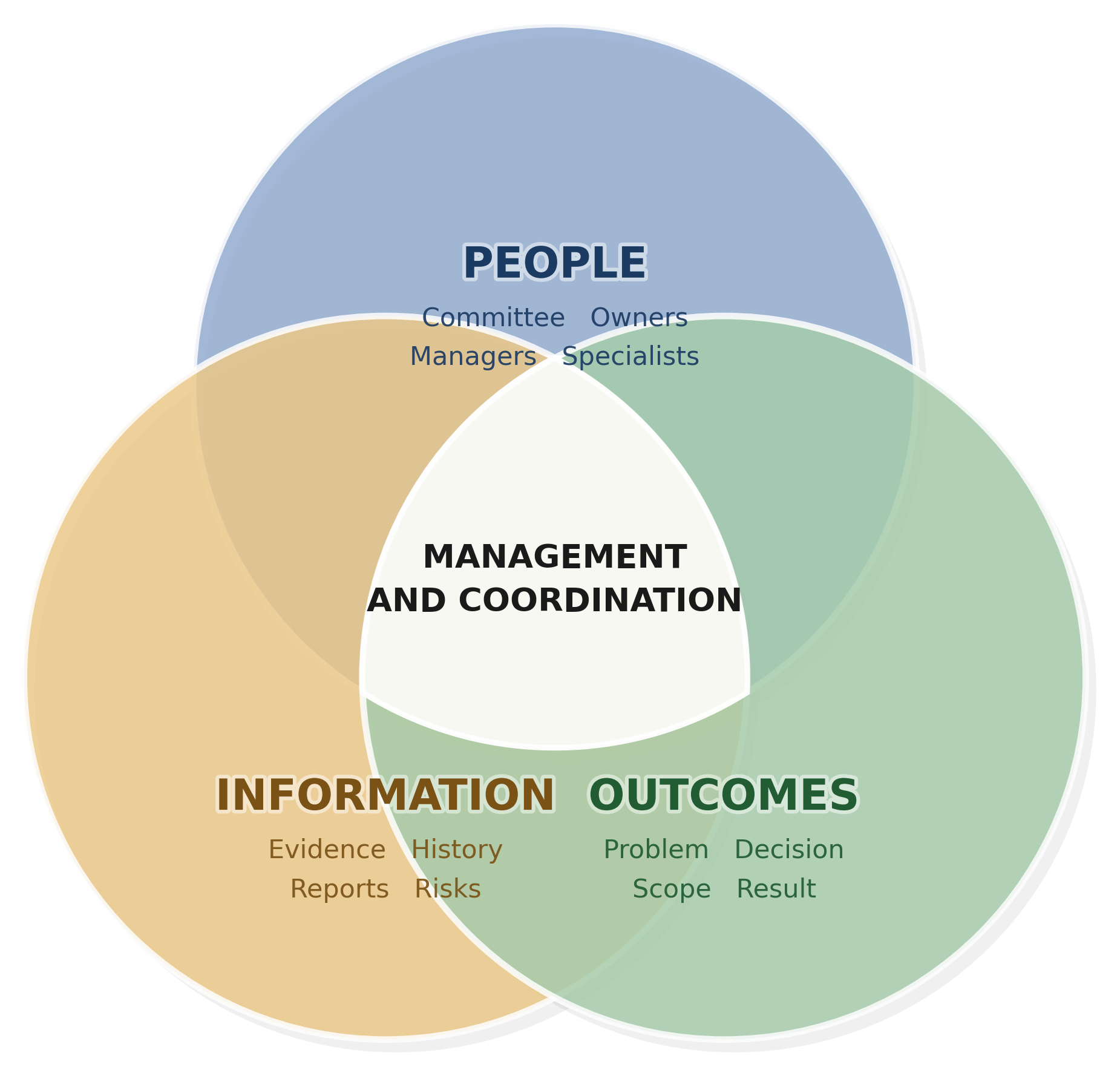
People, information and outcomes must be considered together
The following table provides a quick reference of good practice compared to where alignment is missing.
Element Good alignment When alignment is missing
| Element | Good alignment | When alignment is missing |
|---|---|---|
| People | Committee members, owners, managers and advisers understand their roles, use the same evidence and work towards the same result. | Instructions conflict; information fragments and strong views can displace evidence. |
| Information | Relevant records are organised, reliable and current. Facts, assumptions and information gaps are clearly separated. | Advice is poorly directed, risks are missed, work is duplicated and decisions rest on an incomplete picture. |
| Outcomes | Everyone understands the problem to be resolved, the decision required and how success will be assessed. | Scope expands, priorities compete and activity treats symptoms without resolving the underlying cause. |
This same framework can be used to diagnose problems. When a matter is stuck, ask whether the primary difficulty is the people and their roles, the available information, the intended outcome, or a combination of all three. That diagnosis often shows what must be resolved before another specialist is appointed.
Define the problem before choosing the next specialist
A problem usually announces itself through a symptom: water on a wall, an increasing service charge, an unresolved compliance item, a contractor missing milestones or completed work that has not produced the expected result. The symptom is evidence that something is wrong, but it does not necessarily establish the cause.
For example, water continuing to enter after a major waterproofing project may indicate defective work. It may also come from an area outside the original scope, another defect with a similar symptom or several contributing causes. Until those possibilities are tested, the continued leak alone does not establish responsibility.
Before appointing another specialist or committing to a solution, a committee should answer four questions:
- What do we know. Identify the facts supported by records, observations or reliable professional evidence, including what happened, when it happened and what work has already been undertaken.
- What do we presently believe. Record the competing explanations and concerns. They may be reasonable, but they remain possibilities until sufficient evidence supports them.
- What do we not know. Identify missing records, unanswered questions and gaps in the history. Turn each material gap into a focused question for the appropriate professional.
- What must be decided now. The immediate decision may be a defined investigation or comparison of two approaches, rather than approval of an entire strategy.
Better preparation makes specialist advice more useful
Professional advice is more useful when the client supplies organised information and asks a focused question. Sending a lawyer years of correspondence and asking what can be done may require substantial work before the legal analysis begins. A concise chronology, the relevant agreement, the available evidence, the outcome sought and a clear list of questions make a stronger brief.
That preparation does not replace the lawyer. It allows the lawyer to concentrate on the work that requires legal expertise. The same principle applies to engineers, fire practitioners and other specialists. Good preparation can reduce duplicated effort, reveal missing evidence and make professional fees more productive.
Prepare the committee and owners to make the decision
Committee members may hold strong and sincere views about cause, responsibility, urgency and affordability. Different experience can improve a decision when facts are separated from opinions, uncertainty is acknowledged and assumptions can be challenged respectfully.
Alignment does not require artificial unanimity. It means the committee has examined the material issues, considered reasonable alternatives and developed a recommendation with genuine majority support. Significant dissent should be understood and properly recorded before the proposal reaches the wider ownership.
When approval is required at an annual or extraordinary general meeting, owners need a clear account of the problem, the evidence and professional advice, the options considered, the recommended approach, the expected cost, the risks of delay or inaction, and the precise decision being requested. A sound proposal can fail if owners cannot follow the reasoning behind it.
When independent coordination may help
Some schemes have the internal capability and available time to perform this work. Others may benefit from an independent person working alongside the committee, strata manager, building manager and relevant specialists. Whomever does the coordination role (internal or external) the aim is to assemble the history and evidence, identify the underlying issue and missing information, connect the relevant professional advice, keep the work directed towards an agreed outcome, and prepare the committee and owners to make an informed decision.
This activity does not replace legal, engineering, financial, certification or licensed strata-management advice, and it does not take the decision away from the committee or owners.
A committee may hesitate before spending more money on preparation. The practical comparison is the cost of gaining clarity against the potential cost of unnecessary work, repeated investigations, unclear instructions, failed proposals or action that does not solve the underlying problem.
The first investment should be in gaining clarity
A strata committee does not need to become expert in every discipline. It needs enough organised information and coordinated advice to understand the problem, assess the risks, compare the options and explain its recommendation to owners.
Before committing significant money to a solution, ask three questions:
- Are the right people involved?
- Is the information reliable and complete enough for the next decision?
- Is the required outcome clear?
If one of those elements is missing, the committee may not yet be ready to choose a solution. Proceeding regardless can lead to avoidable delay, expense and unintended consequences.












Comments
Log in to leave a comment