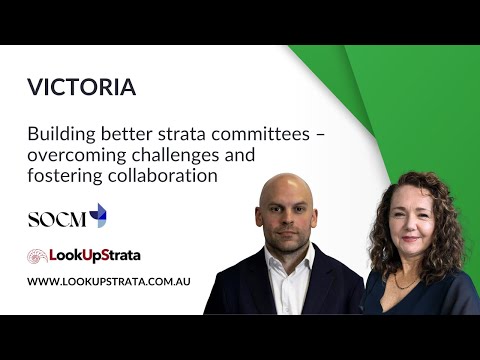
Not every heated owners corporation meeting is a sign that something has gone seriously wrong. But knowing the difference between healthy disagreement and genuine dysfunction, and understanding what happens when you get it wrong, could save your building years of pain and significant financial damage. Julia Moroz, Partner at Bugden Allen Group Legal, and Alex McCormick, Managing Director of SOCM, joined LookUpStrata for a Victorian webinar that covered exactly that.
VIC: Disagreement vs. Dysfunction – The Committee Dilemma | Julia Moroz, Bugden Allen Group Legal and Alex McCormick, SOCM – May 2026

The problem is paralysis, not disagreement
Conflict in a committee isn’t automatically a red flag. Alex even argued that, as long as decisions are being made, conflict can be a sign of a healthy, engaged committee. The problem begins when the decision-making stops. Functioning committees debate, vote, and move on. When the same issues are repeatedly litigated, maintenance decisions are blocked because the committee’s looking for a quote at last year’s prices, or one or two dominant voices stall progress, it becomes clear that governance is starting to break down.
How governance drift starts
Julia and Alex agree that most dysfunctional owners corporations didn’t get there through bad intentions. They got there through small decisions made under pressure, like:
- keeping levies artificially low to avoid complaints
- Deferring maintenance for another year
- owners skipping the AGM because they assume someone else will handle it.
Individually, none of these feel like a crisis. Over time, they compound into one.
Julia noted that the two biggest red flags she sees in her practice are threats to financial stability and failure to maintain common property. These are also the issues most likely to escalate. In Victoria, defect claims and water ingress disputes are among the most common triggers, with owners corporations sometimes spending more on legal costs than maintenance would cost in the first place.
What VCAT actually looks at, and what it doesn’t
A difficult committee is not the same as a legally dysfunctional one, and Julia was clear that VCAT doesn’t hand out administrator appointments easily. Personality clashes, heated meetings, and owners who don’t get along are not enough. The tribunal considers whether the owners corporation can still make effective decisions, meet its obligations under the Owners Corporations Act 2006 (Vic), manage its finances responsibly, and work in the interests of all lot owners. When those things repeatedly and significantly break down, that’s when the question of administration becomes real.
Administration is a last resort, and it comes at a cost
For anyone thinking that VCAT intervention is a straightforward fix, Julia states it isn’t. Once an administrator is appointed, owners and the committee entirely lose decision-making control. The administrator steps into the shoes of the owners corporation and can approve maintenance, manage disputes, engage contractors, and critically, take out loans on behalf of the OC. As Alex pointed out, the administrator could commit the building to a 15-year loan, and no one on the committee will have a say. Administrators can also cost hundreds of dollars an hour, engage auditors and third parties, and the recovery process can take years. An intervention may resolve the immediate crisis, but, as Julia put it, it doesn’t always repair the underlying culture.
Prevention vs crisis management: Which one is cheaper?
So, what does good governance look like in practice? This section of the session centred on realistic budgeting, transparent communication about spending decisions, proper record-keeping of votes and minutes, and committees that understand their obligations under the Act. Julia reminded us that if the warning signs are clear and the still committee won’t act, the strata manager’s job is to be the reality check in the room. If the conversation doesn’t happen now, it will eventually happen at a legal desk at a much higher cost.
When asked for their single best piece of advice for committees, Julia said educate yourself. A lack of knowledge, not bad intentions, is what drives most dysfunction. Alex also kept it simple, suggesting owners be willing to disagree, vote, and then move on. Alex believes that nobody on their deathbed wishes they’d spent more time arguing in an owners corporation committee.
Download the presentation slides
This article is based on the LookUpStrata webinar Disagreement vs. Dysfunction: The Committee Dilemma, presented by Julia Moroz and Alex McCormick. Download the presentation slides from the webinar here: Disagreement vs. Dysfunction – The Committee Dilemma.
This post appears in Strata News #792.
Julia Moroz Bugden Allen E: julia@bagl.com.au P: 03 8582 8100
Alex McCormick SOCM alex@socm.com.au P: 03 9495 0005