Question: Owners in our building want to install individual split system air conditioners, but the building wasn’t designed for them. How should the owners corporation manage requests?
I am the chairperson of an owners corporation for a building with 100 small lots. The provision of student accommodation was the sole activity of the site until approximately 2008, when legislative and policy changes led to its use extending to owner occupiers and tenancies from the wider community. The buildings are now occupied by a mixture of residents, including owner occupiers, students, and tenants on long and short term rental agreements.
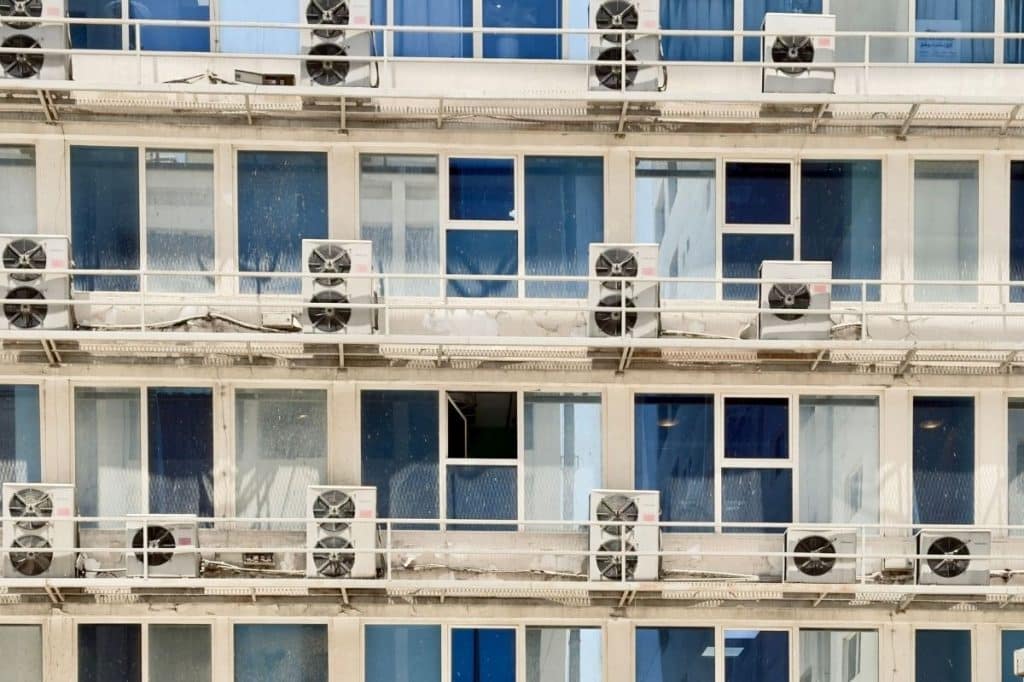
Recent changes to the provision of compliant heating, and the upcoming requirements for air conditioning in rental properties, have caused quite a conundrum. The only viable option is to install individual split air systems. A rough draft plan was drawn up a few years ago, but it does not cover all lots, and we are now receiving applications from lots that are not covered. The building was built in 1999 and is not designed for such installations, and the owners corporation is not happy with the thought of condensers hanging off the building or what could potentially be a huge network of pipes. How should we manage these requests?
Answer: Lot owners have an implied right to run services through common property but cannot alter it, so the owners corporation should determine what property is affected and set rules to manage installations.
There are two scenarios here. First, if lot owners want an owners corporation to carry out works to install air-conditioning, they could do so as a joint project subject to obtaining the required resolution. However, if the issue is about individual lot owners wanting to install their own air conditioning, then a lot owner has certain rights under section 12(2) of the Subdivision Act 1988. That provides a lot owner with an implied easement to install services on or to common property. However, lot owners need to be mindful of section 47A of the Owners Corporations Act 2006, which prohibits lot owners from altering common property. There is a difference between passing a pipe through common property as opposed to altering common property. Further, if it is private lot property that is affected (such as an external private lot wall), then the owners corporation may have a right to provide consent (or not) to an alteration of the external appearance of a lot. The owners corporation first needs to work out whether common property or private lot property is affected. Second, the owners corporation needs to consider which rules apply (model rules or specific registered rules) to determine whether the issue is addressed. If not, an owners corporation might want to pass further rules to govern the installation of air-conditioning to ensure that the external appearance is not adversely affected (to the extent that it is reasonable to do so). A plan needs to be put in place for how the owners corporation is to deal with requests and ensure that all lot owners are treated equitably and in good faith.
This post appears in Strata News #801.
Phillip Leaman Tisher Liner FC Law E: ocenquiry@tlfc.com.au P: 03 8600 9370