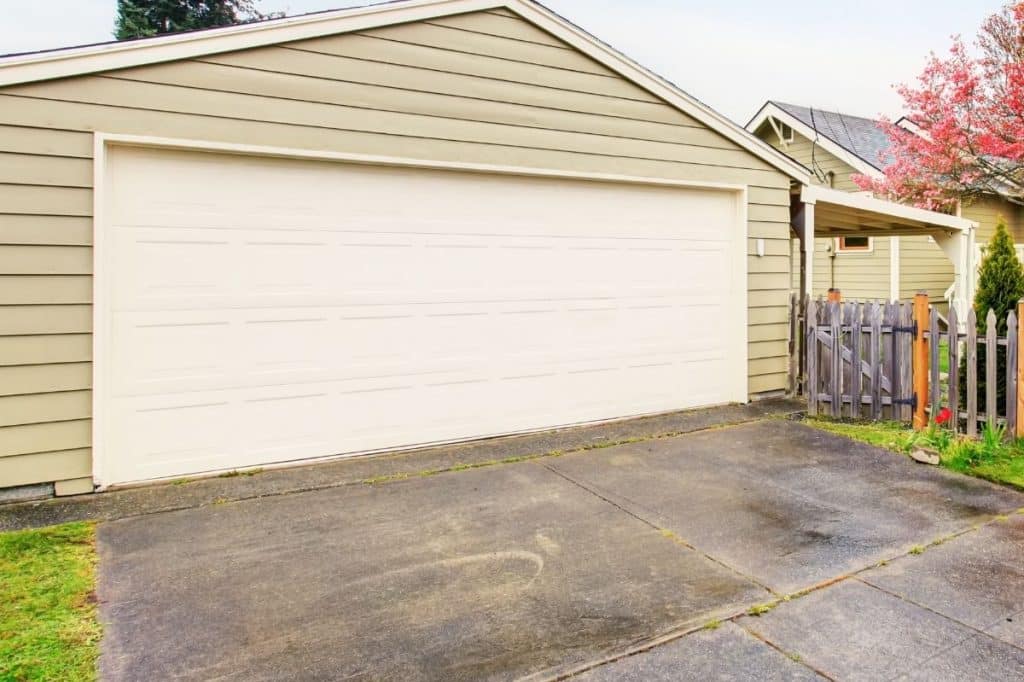
Question: Can a separately titled strata garage be sold independently of the apartment?
We own a strata apartment. In addition, we bought a strata garage with a separate lot number. This is separate from the garage that came with our apartment.
We have been told by another resident that if we sell our apartment, we must also sell this garage. Is this true? Are there penalties if we decide not to sell because we can’t get our asking price?
Answer: The resident is almost certainly wrong. A restriction on a separately titled garage limits who can use it, not whether it can be sold independently of the apartment.
Why your garage is a separate lot in the first place
When a developer wants a car space or garage to be tied permanently to an apartment, the strata plan is normally drawn up so that the car space sits inside the boundaries of the apartment lot, or is allocated to it as common property under an exclusive use by-law. You then can’t sell them separately because, legally, they are one lot.
It is also possible to take a single lot that contains both an apartment and a car space and subdivide it into two separate lots via a strata plan of subdivision under the Strata Schemes Development Act 2015. That’s a formal process requiring a fresh strata certificate (and usually owners corporation involvement). It is the mechanism by which one lot can be split into two, and it’s how some separately titled garages came into existence after the building was originally constructed.
The fact that your garage has its own lot number on the strata plan, whether that was how the scheme was originally registered or as the result of a later subdivision, is itself a strong indicator that it was designed to be capable of being bought and sold independently of the apartment. If the developer or owner wanted them welded together, they wouldn’t have titled them separately.
Your garage is most likely a “utility lot”
A separately titled garage in a residential strata building is almost always what the legislation calls a utility lot. Under section 4 of the Strata Schemes Management Act 2015 (NSW), a utility lot is “a lot designed to be used primarily for storage or accommodation of boats, motor vehicles or goods and not for human occupation as a residence, office, shop or the like”.
This is where the resident’s claim has a kernel of truth, but they’ve got the rule wrong.
The real legal mechanism: a restriction on use
Under section 63 of the Strata Schemes Development Act 2015 (NSW), when a strata plan is registered creating a utility lot, the council or registered certifier may impose, or note from the development consent, a restriction on use. That restriction limits the use of the utility lot to an owner or occupier of another (non-utility) lot in the same scheme.
If your scheme is older, the same kind of restriction may exist but under earlier legislation, most commonly section 39 of the now-repealed Strata Schemes (Freehold Development) Act 1973, which was the predecessor to section 63. Restrictions imposed under section 39 still operate today; they just appear differently on the records. Older schemes may also have relevant notations recorded directly on the strata plan itself, including on the administration sheet, rather than (or as well as) on the title. I’ve seen administration sheets that record a restriction limiting transfer of a utility lot to existing owners in the scheme, which is a slightly different mechanism again. So if you can’t see anything on the title search, it doesn’t necessarily mean there’s nothing. You also need to look at the registered strata plan.
The reason any of these restrictions exist in the first place is exactly what you’d expect: security and amenity. The planning authority doesn’t want a garage in a residential building owned by someone with no other connection to the scheme. Once you own a lot, any lot, including a utility lot, you are a member of the owners corporation with full rights of access to the common property of the scheme: the basement, lifts, lobbies, pool, gym, rooftop terrace, and so on. Restricting who can own or use the garage is the mechanism the planning authority uses to stop that backdoor entry into the scheme.
How to find out whether any restriction actually applies
A few practical steps:
- Get a title search for the garage lot. Any conveyancer can pull this for a small fee, or you can order one yourself through NSW Land Registry Services. If there’s a section 63 (or older section 39) restriction, it will be recorded on the title, usually in the second schedule of the folio.
- Get a copy of the registered strata plan, including the administration sheet. This is particularly important for older schemes, where a restriction or note about ownership or use of utility lots may be recorded on the plan itself rather than on the title.
- Check the registered by-laws for the scheme. The by-laws are registered on the common property title. Don’t rely on model by-laws; check what is actually registered for your scheme.
- Check the original development consent if your conveyancer has it on file. The condition that originally triggered any restriction will be there.
What the restriction does and doesn’t do
This is the part the resident has got wrong.
Even where a section 63 restriction applies, the NSW Land Registry Services Registrar General’s own published guidance on utility lots states plainly that utility lots can be transferred in the same way as any other strata lot, and the restriction does not prohibit any change in ownership.
In other words:
- You do not have to sell the garage at the same time as the apartment.
- You can keep the garage and sell the apartment alone, or sell the garage and keep the apartment, or sell them together.
- The restriction is about use, not ownership or transfer.
What the restriction does mean is that the buyer of the garage must already be (or become) an owner or occupier of another lot in the scheme in order to legally use it. Practically, this narrows your market. Your realistic buyers are other owners in your building who want extra parking or storage. That’s a real commercial limitation, but it is not a legal obligation to package the garage with your apartment.
It’s also worth noting, separately, that section 139(2) of the Strata Schemes Management Act 2015 says “A by-law has no force or effect to the extent that it purports to prohibit or restrict the devolution of a lot or a transfer, lease, mortgage or other dealing relating to a lot.” So if anyone tries to point you to a by-law requiring you to sell the garage with the apartment, that by-law would be invalid to the extent it tries to do that.
What about “penalties”?
There are no statutory penalties for selling, or not selling, your garage at any particular price. The legislation does not punish you for what your garage achieves on the open market.
If the resident is suggesting there could be some form of damages claim because you didn’t sell to a particular person, or didn’t sell with the apartment, that’s a contract or property law question, not a strata one. It would be very unusual for any such liability to exist absent a specific contractual arrangement you’ve entered into. If you’re concerned about that possibility, get advice from a property lawyer rather than relying on what another owner has told you.
Bottom line
Order a title search on the garage, read what’s actually recorded in the second schedule, get a copy of the registered strata plan including the administration sheet, and check the scheme’s registered by-laws. In all likelihood, you’ll find a restriction that limits who can use the garage, not a requirement to sell it with the apartment. The two are very different, and that difference matters when you’re deciding how to handle the sale.
If anything on the title or strata plan is unclear, ask your conveyancer or a strata lawyer to interpret it for you before you make any commercial decisions about the sale.
This post appears in Strata News #809.
Tim Sara Sara Strata E: tim@sarastrata.com.au P: 04 8500 7960